
When you’re on a fertility journey, especially one that includes advanced techniques like ICSI (Intracytoplasmic Sperm Injection), it’s completely normal to wonder what actually happens behind the scenes. We’ve been there with so many couples. That’s why in this article, we explain the ICSI procedure step by step, from an embryologist’s perspective inside the lab.
What Is the ICSI Procedure?
ICSI is one of the ways we help fertilisation happen in the lab. In standard IVF, hundreds of thousands of sperm surround the egg. With ICSI, we select one healthy sperm and place it directly into the egg. We gently assist fertilisation by selecting one healthy sperm and placing it directly into an egg. We often use ICSI when there’s male factor infertility, such as low sperm count or poor motility. It can make the difference between no fertilisation and a viable embryo.
Think of us as matchmakers, giving one carefully chosen sperm the support it needs to reach the egg.
The ICSI procedure, step by step
First, here’s what happens during an ICSI procedure in the Create Fertility lab, step by step.
1. Preparing the eggs and sperm
Before the egg and sperm meet, a lot of preparation has already taken place:
- First, the female partner undergoes ovarian stimulation so we can collect multiple mature eggs.
- We then collect these eggs using the least invasive approach possible.
- At the same time, we prepare the sperm sample, selecting the healthiest and most mobile sperm.
Every egg and sperm are handled in a warm, controlled environment because they respond to temperature and stress, just like we do.
2. Choosing the best sperm
During the ICSI procedure, we carefully select a single sperm under a powerful microscope. We look for sperm that are moving well and look structurally normal. This skill comes from years of training and experience.
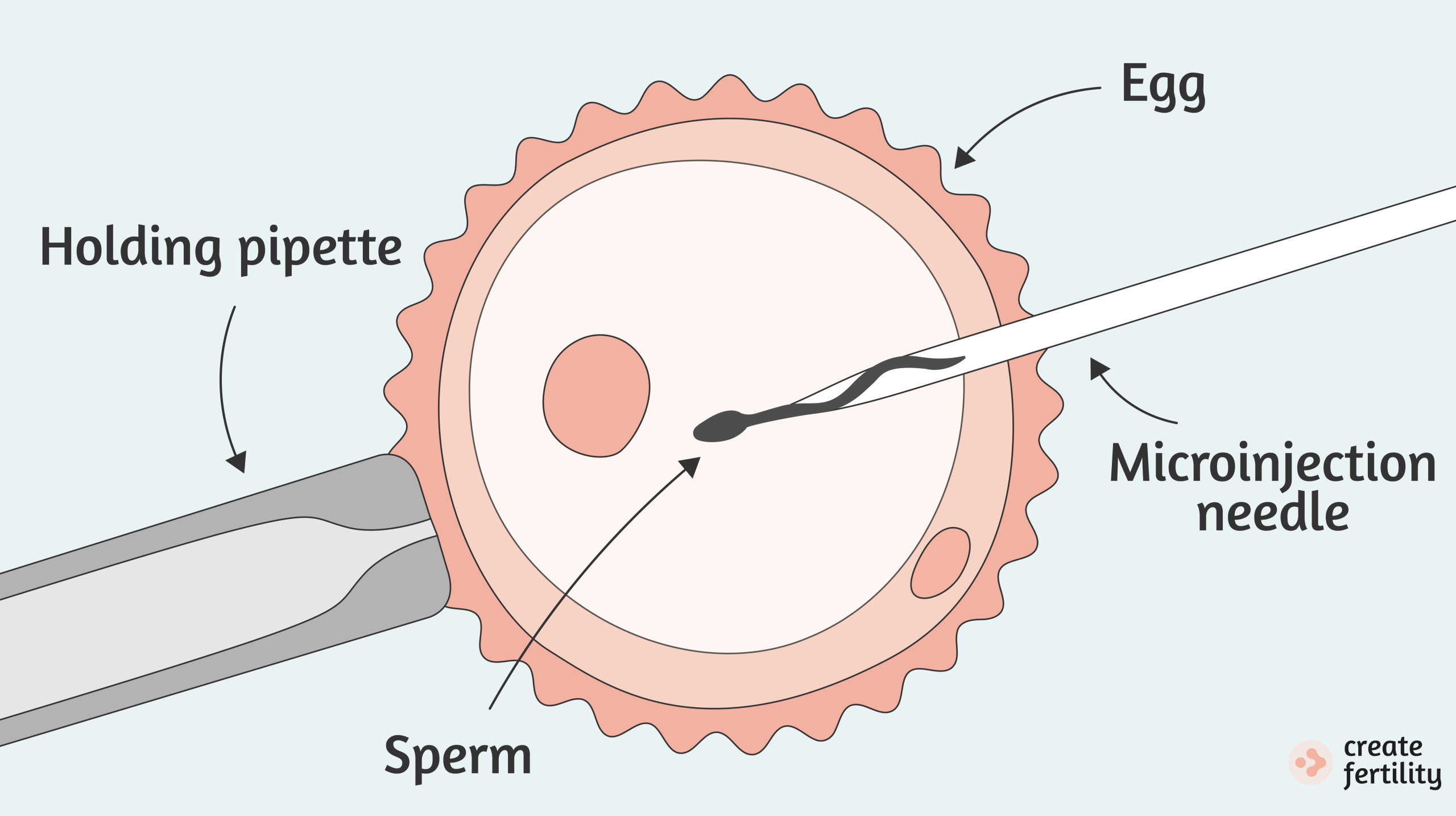
Once we choose a good-looking sperm, we carefully immobilise it, usually by gently flattening its tail with the injection pipette.
3. The microinjection
Now for the moment that makes ICSI unique:
- First, we hold the egg steady with a tiny holding pipette.
- Then, a second, finer needle carries the selected sperm.
- Finally, we gently place the sperm directly into the egg’s cytoplasm.
This is done under a microscope, controlled down to the tiniest movement.
4. After the injection
Once each egg has been injected:
- We place the eggs into an incubator that mimics the environment of the womb.
- We monitor them closely to see if fertilisation happens, usually visible by the next day.
- Over the next few days, embryos begin to divide and grow.
From here, the ICSI procedure is much like standard IVF. Over the following days, we evaluate the embryos and one may be selected for embryo transfer. Any other embryos of suitable quality may be frozen for later use.
ICSI vs IVF: Why ICSI May Be Recommended
At Create Fertility, our fertility specialists will recommend ICSI when:
- There’s low sperm count, poor sperm movement or abnormal sperm shape. Essentially, all factors that make natural fertilisation in a dish less likely.
- Using testicular retrieved sperm from a biopsy sample.
- Previous Standard IVF cycles that did not fertilise, even with good eggs.
- You’re doing genetic testing on embryos before transfer.
- You’re using frozen eggs.
- In some cases, unexplained infertility.
It’s important to know that ICSI doesn’t guarantee success. Nothing in fertility does. However, it can give fertilisation the best possible chance when male factors are present.
A Note From Our Embryology Team
We know the IVF and ICSI journey can feel both hopeful and overwhelming. In the lab, every step we take is done with intention and respect. We honour that these cells represent your dreams and your hope for the future.
Now you know a bit more of the care that goes into ICSI. If you have questions, we’re here to walk beside you every step of the way. Just reach out.